
We are now beginning the next phase of our project, which asks: “How should each core domain be measure“
We will use a transparent and systematic process to identify, assess, and recommend the best measurement instrument(s) for each core domain. A measurement instrument is any tool, scale, or questionnaire used to measure an outcome.
Instrument selection process
Our process for selecting instruments will be informed by the approach developed by the Outcome Measurement in Rheumatology (OMERACT) group.
This is a structured, multistep process. We will follow this process for every instrument being considered in each domain.
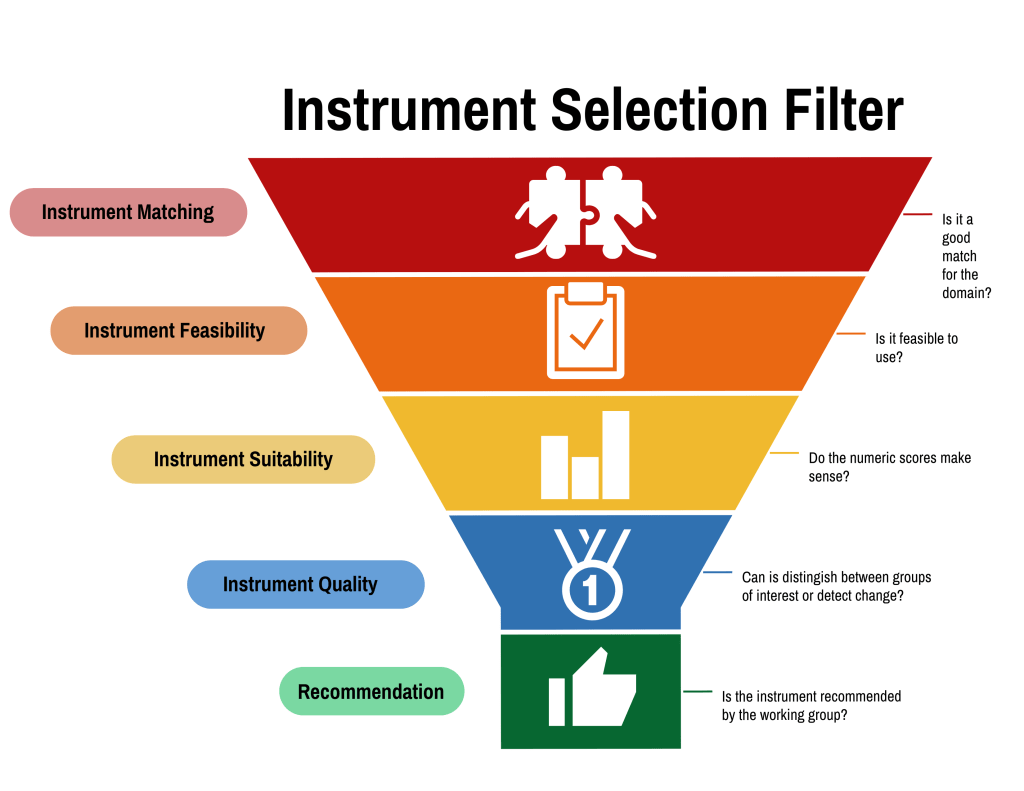
First, we will identify candidate instruments for each domain. Then those instruments will move through an instrument selection filter.
The filter asks four key questions:
- Is the instrument a good match for the domain?
- Is it feasible to use?
- Do the numeric scores make sense?
- Can it distinguish between groups of interest or detect change?
Once we have answered these questions, the working groups will recommend which instrument(s) should be used for measuring their domain.
Step 1: Understand what you are trying to measure
The first step in our process is to make sure that everyone has a clear and shared understanding of the domain that their group is trying to measure.
Step 2: Identify candidate instruments
Next, we need to identify the candidate instruments that could potentially measure each domain.
The study team has already completed much of this background work by reviewing the literature and identifying instruments used in previous research.
Step 3: Domain match assessment
The first key question will be:
Is the instrument a good match for the domain as we have defined it?
This question will assess two related concepts.
The first is face validity: does the instrument appear to measure what it should?
The second is content validity: does the instrument capture all the important aspects of the domain?
This step ensures that any instruments we move forward actually measure the outcomes that we care about.
Step 4: Feasibility assessment
The second key question will be:
Is the instrument feasible to use?
Feasibility includes practical considerations such as cost, time, accessibility, language availability, and ease of administration.
Working groups will consider feasibility from two perspectives.
First, working groups will consider the burden on the respondent or patient. For example, they will consider how much time, effort, or discomfort is involved in administering the instrument and whether it is understandable or acceptable for patients.
Second, working groups will consider the burden on the person, team, or system administering the instrument. For example, they will consider whether there are costs, licensing requirements, training needs, or equipment that could make the instrument impractical to use.
This step ensures that recommended instruments are realistic to use in research and practice.
Step 5: Narrow the field
After the domain match and feasibility assessments, our steering committee will review the results from the working groups.
The steering committee will then decide whether each instrument should move forward for full evaluation or be set aside because of concerns raised about its domain match or feasibility.
This step will narrow the field to the most relevant instruments that are worth the time and resources needed for full evaluation.
Step 6: Gather the evidence
For the instruments that move forward, the study team will find and summarize the available evidence on their measurement properties.
Step 7: Identify top instruments
Working groups will then review the evidence summaries prepared by the study team and answer the final two questions in the instrument selection filter.
Do the numeric scores make sense?
And
Can it distinguish between groups of interest or detect change?
The steering committee will review the results and recommend the top instrument(s) from each group for formal ratification.
Step 8: Endorsement
The final step is endorsement.
Working groups will present a summary of their findings and recommendations to the wider international aSAH community.
After an opportunity for review and comment, we will hold a vote on whether the recommended instruments should be endorsed as part of our Core Outcome Set.

